



Education Financing: Navigating Fiscal Constraints, Driving Transformation
Education Financing: Navigating Fiscal Constraints, Driving Transformation
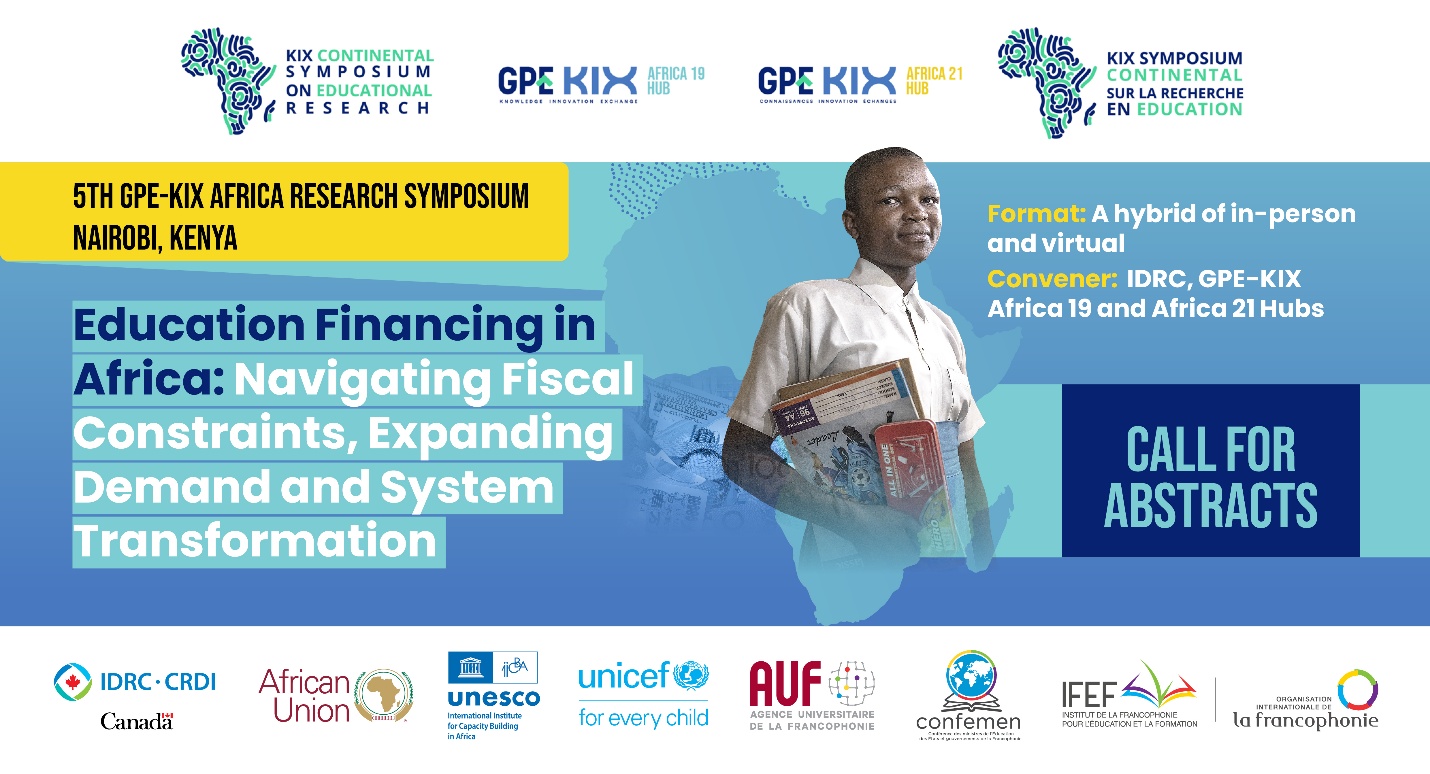
Deadline for submission of abstracts: June 30, 2026
-
Background and Context
As part of the Knowledge and Innovation Exchange (KIX), a joint initiative of the Global Partnership for Education (GPE) and the International Development Research Centre (IDRC), the GPE-KIX Africa 19 and Africa 21 Hubs are organizing the 5th GPE-KIX Africa Research Symposium.
The Symposium will convene policymakers, Ministries of Education and Finance, researchers, development partners, regional institutions, civil society, and practitioners to examine how African countries are financing education systems amid growing fiscal pressure, rising demand, and increasing calls for system transformation.
Across sub-Saharan Africa, education systems face mounting pressures linked to demographic growth, constrained fiscal space, rising public debt, climate shocks, persistent inequality, and expanding demand for secondary education and skills development. While countries continue to pursue ambitious reform agendas, financing systems are under increasing strain. The challenge is no longer only about mobilizing more resources, but also about improving allocation efficiency, strengthening domestic financing, prioritizing equitable investments, and sustaining learning outcomes at scale.
The Symposium seeks to bridge the gap between research, policy, and financing decisions by showcasing evidence on financing reforms, expenditure strategies, allocation models, and institutional approaches that have demonstrated policy uptake, financial commitment, and system-level impact.
-
Symposium Objectives
-
Examine evidence on education financing reforms and allocation decisions that have improved access, equity, inclusion, and learning outcomes;
-
Strengthen shared understanding of sustainable and equitable financing approaches across the education lifecycle;
-
Promote efficiency, data-informed decision-making, and value for money in education financing;
-
Generate actionable insights on financing reform, implementation pathways, and political economy considerations shaping education transformation.
-
Call for Abstracts
Researchers, policymakers, practitioners, government institutions, development partners, and civil society organizations are invited to submit abstracts aligned with the Symposium theme.
Submissions should present completed or ongoing research, policy experiences, financing reforms, implementation lessons, or evidence-informed practices related to education financing and system transformation in Africa.
The Symposium particularly welcomes submissions demonstrating:
-
Policy uptake or financing commitment;
-
Evidence-informed financing reform;
-
Allocation efficiency and expenditure tracking;
-
Sustainable domestic financing approaches;
-
Equity-focused financing models;
-
Scalable and system-level impact.
-
Thematic Areas
Abstracts may address one or more of the following thematic areas:
-
Financing for access and equity
Guiding question: What financing decisions have improved equity in access, learning, and resource allocation?
-
Evidence on financing reforms that have expanded access for marginalized or OOSC
-
Allocation formula reforms reducing geographic, gender, or socio-economic disparities
-
Budgetary measures strengthening inclusive or gender-responsive programming
-
Evidence linking equity-focused financing to improved participation or learning outcomes.
-
Evidence on gender-responsive, disability-inclusive, and geographically equitable allocations
-
Financing for ECE, foundational learning, and the teacher workforce
Guiding question: What financing reforms have improved early learning and teacher effectiveness?
-
Evidence on financing expansion of equitable access to pre-primary education.
-
Integration of pre-primary within national education financing frameworks.
-
Evidence on reforms associated with improvements in foundational learning.
-
Sustainable financing of teacher professional development, including instructional support systems.
-
Budgetary reforms strengthening teacher training, deployment, retention and CPD systems.
-
Wage bill management enhancing sustainability without compromising quality.
-
Financing for skills and secondary-age pathways
Guiding question: Where have financing decisions enabled scalable and sustainable skills pathways?
-
Financing strategies that enabled expansion of secondary education or skills development.
-
Budget reallocations or new funding instruments supporting flexible pathways for adolescents.
-
Evidence of alignment between education financing and labour market transitions.
-
Demonstrated fiscal commitments for second-chance or non-formal education programs.
-
Financing for second-chance and non-formal education, especially for marginalized youth.
-
Financing for data systems reform, technology, and system efficiency
Guiding question: Have investments in data and technology improved efficiency and decision-making?
-
Financing reforms that strengthened EMIS, data governance, or linkage with PFM systems.
-
Evidence of use of data to inform allocation formula reform or expenditure reprioritization.
-
Investments in learning assessment systems that directly shaped financing decisions.
-
Investments in digital public infrastructure that improved system performance or accountability.
-
Evidence of digital infrastructure and cost-effective EdTech integrated into systems.
-
Cases where data system reforms were institutionalized within national planning and budgeting.
-
Financing for resilience, peace, climate, and crisis response
Guiding question: What financing mechanisms have strengthened system resilience and learning continuity?
-
Budget reforms integrating climate adaptation or disaster risk reduction.
-
Evidence on financing mechanisms that ensured equitable continuity of learning during crises.
-
Sustainable integration of school nutrition or safe learning within national budgets.
-
Shock-responsive financing instruments with demonstrated operational results.
-
Financing strategies supporting education as an investment in fragile and conflict-affected contexts.
Across all clusters, the Symposium will prioritize evidence-based contributions, focusing on implemented reforms, documented financial commitments, and measurable system-level results.
Cross-cutting considerations such as political economy, inclusion, gender equality, resilience, efficiency, and system transformation are encouraged across all thematic areas.
-
Submission Guidelines
Abstracts may be submitted in English, French, or Portuguese.
Each submission should include:
-
Title of the presentation/paper;
-
Name(s), institutional affiliation(s), and contact details of author(s);
-
Identification of presenting author;
-
Abstract of 300 words including:
-
Background/context;
-
Research or implementation approach;
-
Key findings/results;
-
Policy or financing implications.
Submissions may include:
-
Research papers;
-
Policy analyses;
-
Country case studies;
-
Implementation experiences;
-
Financing reform documentation.
-
Selection Criteria
Submissions will be reviewed based on:
-
Relevance to the Symposium theme;
-
Quality and rigor of evidence;
-
Policy and financing relevance;
-
Clarity of analysis and lessons learned;
-
Demonstrated or potential system-level impact;
-
Contribution to peer learning and knowledge exchange.
Priority will be given to submissions demonstrating concrete policy uptake, financing reform, or measurable implementation results.
-
Important Dates
|
Activity |
Date |
|
Launch of Call for Abstracts |
18 May 2026 |
|
Deadline for Submission |
30 June 2026 |
|
Notification of Accepted Abstracts |
31 July 2026 |
|
Submission of Final Presentations/Papers |
XX September 2026 |
|
Symposium Dates |
20–22 October 2026 |
-
Submission Process
Abstracts will be submitted through an online submission platform.
-
Questions and Enquiries
For questions regarding the Call for Abstracts, please contact:
N.B.: Below are the countries participating in KIX Africa 19 and 21 Hubs:
The KIX Africa 19 Hub comprises the following 19 GPE partner countries in anglophone Africa: Eritrea, Eswatini, Ethiopia, The Gambia, Ghana, Kenya, Lesotho, Liberia, Malawi, Mozambique, Nigeria, Rwanda, Sierra Leone, Somalia, South Sudan, Tanzania (mainland and Zanzibar), Uganda, Zambia, and Zimbabwe.
The KIX Africa 21 Hub includes the following 21 GPE partner countries in francophone Africa: Benin, Burkina Faso, Burundi, Cabo Verde, Cameroon, Central African Republic, Chad, Comoros, Côte d'Ivoire, Democratic Republic of Congo, Djibouti, Guinea-Bissau, Guinea, Madagascar, Mali, Mauritania, Niger, Republic of Congo, Senegal, Togo, Sao Tome and Principe
Download Education Financing: Navigating Fiscal Constraints, Driving TransformationTélécharger Financement de l'éducation : surmonter les contraintes budgétaires, être le moteur de la transformat
Click Here To Submit Abstract (English) Cliquez ici pour soumettre un résumé (Francais)
-
Share:


