




4th KIX Knowledge Café Traces the Journey from Education Data to Policy Decisions
4th KIX Knowledge Café Traces the Journey from Education Data to Policy Decisions
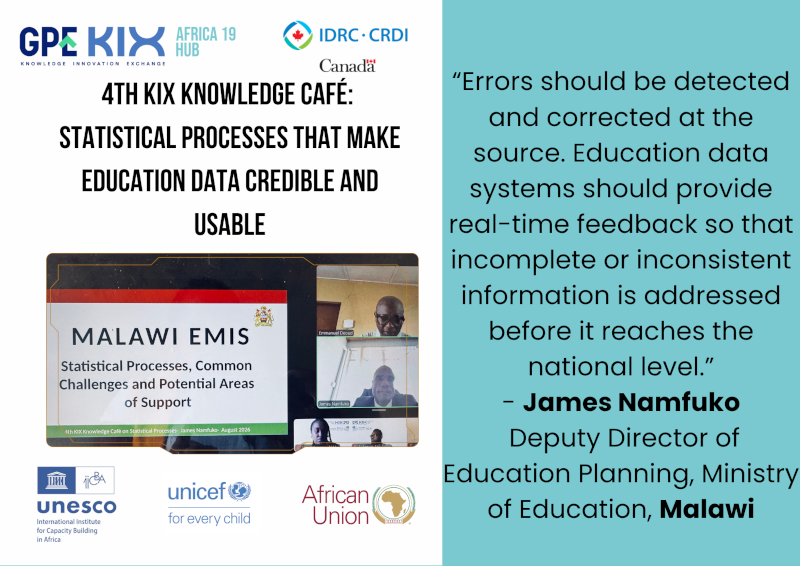
The 4th KIX Knowledge Café on Statistical Processes in Education Management Information Systems (EMIS) was convened on 25th August 2026 by the African Union’s Pan-African Institute for Education for Development (AU-IPED), through the Global e-Schools and Communities Initiative, and under the Global Partnership for Education Knowledge and Innovation Exchange (GPE KIX) Africa 19 Hub - a joint endeavour with Canada’s International Development Research Centre.
The virtual Café brought together education officials and data practitioners from 12 African countries, alongside education researchers and development partners, to exchange national experiences and identify priorities for strengthening statistical processes in education management information systems (EMIS).
Education data collected by schools is compiled, validated and analyzed before becoming national statistics used for planning and policymaking. If incomplete records, duplicate entries or inconsistent figures are not identified during this process, they can affect the accuracy of these statistics and their ability to guide decisions that strengthen education systems and respond to learners’ needs. The Café examined how countries can strengthen each stage of the data cycle to produce credible, timely and usable education statistics.
Delivering the thematic intervention, Polycarp Otieno, Education Specialist at UNICEF’s Eastern and Southern Africa Regional Office - one of the three organizations forming the KIX Africa 19 Hub consortium, emphasized that the credibility of education statistics is ultimately demonstrated through their use in decision-making. He explained that credibility requires completeness, plausibility, consistency, reproducibility and timeliness, with validation beginning at collection.
Country presentations then illustrated how these principles are being applied, and where gaps remain. Sierra Leone’s KIX focal point, Emmanuel Vandy Deoud, described a layered quality-assurance process combining office editing, field checks, telephone verification, data cleaning and independent validation. James Namfuko, Malawi’s Deputy Director of Education Planning, outlined the country’s progress in digitizing its largely paper-based EMIS through subsector platforms, while noting that these platforms are not yet connected within a single, integrated national EMIS.
This revealed a wider policy issue, that digitalization can accelerate collection, but without common standards, interoperable platforms, clear responsibilities and skilled personnel, it may produce fragmentation. Participants called for data-exchange mechanisms, analytical and quality-assurance capacity, coordination between EMIS units and National Statistics Offices, and peer exchanges with countries demonstrating interoperability and validation practices.
Responding to the discussion, AU-IPED Policy Officer for EMIS Lukman Jaji, highlighted that an education data system combines people, processes, technology and tools, and that digitizing a weak process only automates its weaknesses. He reaffirmed that support through the KIX Africa 19 Hub could target country-identified priorities through technical assistance, capacity-building and peer learning, subject to available resources.
By strengthening the processes that turn school-level records into national statistics, the Café priorities advance the Continental Education Strategy for Africa 2026–2035, particularly its objectives on evidence-based policy and governance and stronger monitoring and evaluation, and contribute to Agenda 2063. Credible and timely education data also enables countries to monitor progress towards Sustainable Development Goal 4 and make informed decisions that advance inclusive and equitable quality education.
The Café reinforced that credible statistics are not produced by software alone. They emerge from accountable people, institutions and processes protecting data quality from school registers to policy decisions.
Read the full meeting report here.
-
Share:


